BHP share price (ASX: BHP): 2026 performance, the copper flip and a strike that could change everything

J
James Whitfield Jul 18, 2026 · 5 min read
0
BHP share price (ASX: BHP): 2026 performance, the copper flip and a strike that could change everything

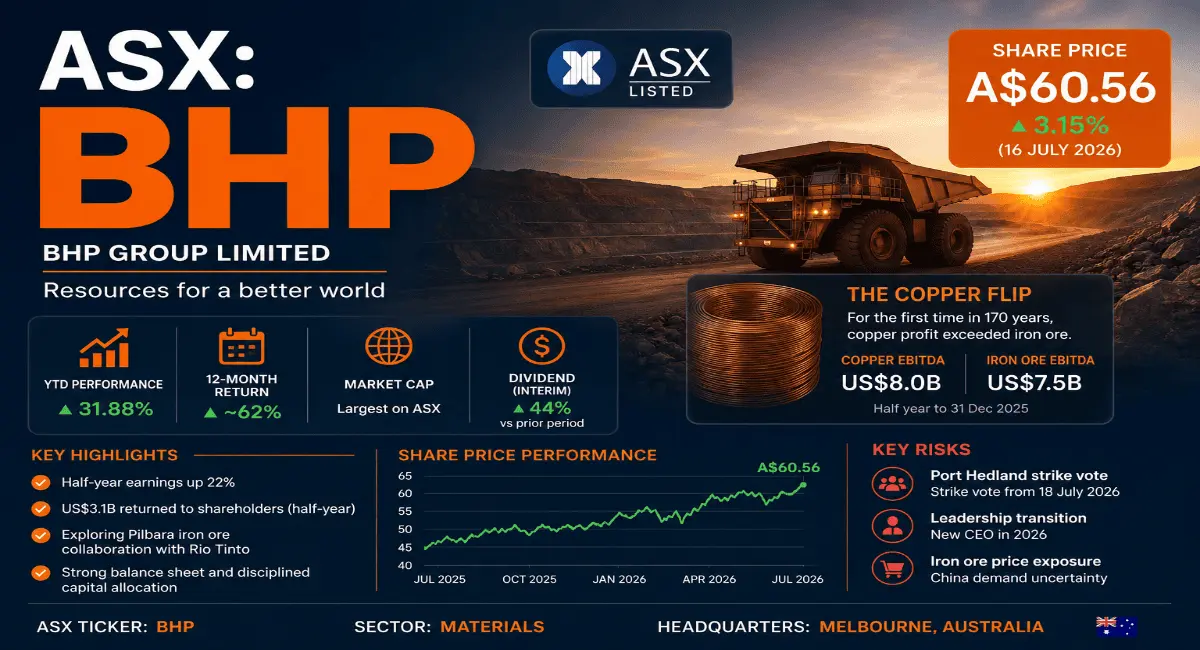
The short version: BHP is up 31.88% this year and currently trading at AU$60.56. Copper just beat iron ore as its biggest profit driver — the first time that's happened in 170 years. Earnings jumped 22% in the last half-year result, and the dividend surged 44%. The thing worth watching right now, though, is a Port Hedland worker strike vote scheduled for July 18.

Table of Contents

How BHP has traded in 2026

Why is BHP up so much?

What the last earnings report actually said

Dividends in 2026

The risks investors are watching
Bull case vs bear case


How BHP has traded in 2026

BHP (ASX: BHP) is at AU$60.56 today, July 16, up 3.15% on the session. That one-day move adds to a year that has already delivered 31.88% gains for shareholders — and roughly 62% over the past 12 months

To put the 12-month number in context: most ASX large-caps have not come close. BHP's run has been driven by something more fundamental than sentiment — the company's earnings profile genuinely changed in 2026.

It also officially reclaimed the title of Australia's most valuable listed company, edging out Commonwealth Bank. Analysts expect that gap to widen, not close, given where commodity markets are heading.

Why is BHP up so much?

Three things, and they're all connected.

Copper has taken over. For the first time in BHP's 170-year history, copper generated more profit than iron ore. Copper EBITDA came in at $8.0 billion versus iron ore's $7.5 billion for the half-year to December 2025 That gap will likely widen as BHP's copper production grows and its iron ore exposure stays roughly flat.

Why does this matter to investors? Copper is the metal that electrification runs on. Every EV, every data centre, every grid upgrade requires it. BHP spent years and billions positioning itself there through the OZ Minerals acquisition and expansion at Escondida. The payoff is now showing up in the numbers.

Record copper prices gave it a boost. In late January, BHP shares jumped 1.7% in a single session after copper hit record prices. Price moves like that flow almost directly into margins given BHP's scale.

The Rio Tinto collaboration talks. In January 2026, BHP and Rio Tinto announced they were exploring a joint mining arrangement covering up to 200 million tonnes of Pilbara iron ore. The logic is cost efficiency — shared infrastructure in a region where both companies are dominant. If it proceeds, it would be one of the more consequential deals in Australian mining in a generation.

What the last earnings report actually said

BHP's half-year results for the six months to December 31, 2025, released February 17, were a genuine beat:

  • Earnings up 22%
  • Copper EBITDA of $8.0 billion beat iron ore's $7.5 billion — the first   time copper has topped the table
  • Shares jumped 7% on results day — the best single-session gain   since March 2020
  • Total dividends paid to shareholders reached US$3.1 billion for the       half year

The 7% share price reaction on results day is the real signal here. Markets had clearly underestimated how fast the copper transition would show up in the profit and loss statement. Morningstar noted the bullish market response, with a 5% gain on the day of the interim result.

Dividends in 2026

BHP's interim dividend — paid in March 2026 — jumped 44% compared to the prior period,

Total shareholder payments reached US$3.1 billion for the half, per BHP's official results document.

The ASX ex-dividend date for BHP's most recent final dividend was March 4, 2026, per the BHP dividend page.

BHP pays dividends twice a year: an interim (typically February/March) and a final (typically September/October). The 44% jump in the interim was a direct result of the earnings surge — BHP's payout ratio policy ties dividends to underlying earnings, so stronger profits mean larger distributions. Income investors should track the September announcement date for the FY2026 final.

The risks investors are watching

The Port Hedland strike

This is the most immediate risk, and it's happening now. As of early July 2026, three separate unions at BHP's Port Hedland iron ore operations have voted in favour of strike action. Workers are scheduled to vote on actual strike commencement from July 18.

Union leaders have publicly stated that iron ore exports could grind to a halt if action proceeds. Port Hedland is Australia's largest bulk export port — any disruption to throughput directly hits BHP's iron ore revenue. This is worth watching closely in the days ahead.

New CEO transition

BHP is navigating a leadership change in 2026. As Yahoo Finance noted in May, new leadership during a period of strategic repositioning introduces execution risk. It's not necessarily a reason to sell, but it's a legitimate uncertainty — particularly around how aggressively BHP pursues its copper growth plans.

Iron ore price exposure

Copper may now be the earnings leader, but iron ore is still a massive revenue stream. China's property sector has yet to find a bottom, which caps iron ore price upside. If Chinese steel demand softens further, that $7.5 billion EBITDA from iron ore comes under pressure.

Bull case vs bear case


Bull case

Bear case

Copper

EV, AI infrastructure, and grid demand structurally supports copper prices for years

Short-term demand softness could compress margins

Iron ore

Rio Tinto collaboration could cut costs at scale

Port Hedland strike could disrupt shipments; China demand uncertain

Dividend

44% jump shows real cash generation confidence

USD-denominated payouts expose AUD investors to currency moves

Valuation

One analyst estimate puts BHP 49.5% undervalued at June 2026 prices

Valuation score of just 1 out of 6 by the same analysis — not cheap on traditional metrics


Source : Market Analysis

How has the BHP share price performed in 2026?
BHP shares have gained 31.88% year-to-date in 2026 and approximately 62% over the past 12 months.
Why has BHP's share price risen so much in 2026?
The main drivers are copper becoming BHP's largest profit contributor, record copper prices, strong half-year earnings, higher dividends, and investor optimism around the proposed Rio Tinto Pilbara collaboration.
Why is copper now more important than iron ore for BHP?
For the first time in BHP's 170-year history, copper generated more profit than iron ore, with copper EBITDA reaching US$8.0 billion compared to iron ore's US$7.5 billion.
Why is BHP focusing on copper?
Copper demand is expected to grow due to electric vehicles, AI infrastructure, data centres, and power grid upgrades. BHP has expanded its copper business through investments such as the OZ Minerals acquisition and Escondida expansion.
How did record copper prices affect BHP shares?
Record copper prices boosted investor confidence and profitability. In late January 2026, BHP shares rose 1.7% in a single trading session following copper's price rally.
What is the proposed Rio Tinto collaboration?
BHP and Rio Tinto announced they are exploring a joint mining arrangement covering up to 200 million tonnes of Pilbara iron ore to improve cost efficiency through shared infrastructure.
What were the highlights of BHP's latest earnings report?
The half-year results showed earnings increased 22%, copper EBITDA exceeded iron ore EBITDA for the first time, shareholders received US$3.1 billion in dividends, and the share price jumped about 7% after the announcement.
When were BHP's latest half-year results released?
BHP released its half-year results for the six months ended December 31, 2025, on February 17, 2026.
How much did BHP's dividend increase in 2026?
BHP's interim dividend paid in March 2026 increased by 44% compared to the previous corresponding period.
How much did BHP return to shareholders?
BHP paid approximately US$3.1 billion in dividends to shareholders during the latest half-year period.
How often does BHP pay dividends?
BHP typically pays dividends twice a year, with an interim dividend around February or March and a final dividend around September or October.
What is the biggest short-term risk facing BHP?
The most immediate risk is potential strike action at Port Hedland, where workers are scheduled to vote on strike commencement from July 18, 2026. Any disruption could affect iron ore exports.
Why is the Port Hedland strike important?
Port Hedland is Australia's largest bulk export port. Any prolonged disruption could reduce BHP's iron ore shipments and negatively impact revenue.
Is BHP undergoing a leadership change?
Yes. BHP is transitioning to a new CEO in 2026, creating some execution risk as the company continues its strategic shift toward copper.
Does BHP still depend on iron ore?
Yes. Although copper has become the largest profit contributor, iron ore remains a major source of revenue and earnings for the company.
How could China's economy affect BHP?
Weakness in China's property sector and lower steel demand could reduce iron ore prices, putting pressure on BHP's iron ore earnings.
What is the bullish investment case for BHP?
Supporters point to long-term demand for copper driven by electrification, AI infrastructure, potential cost savings from the Rio Tinto collaboration, strong dividend growth, and estimates suggesting the shares may be undervalued.
What is the bearish investment case for BHP?
Risks include weaker copper demand, disruption from the Port Hedland strike, uncertainty in China's iron ore demand, currency exposure for Australian investors receiving USD-denominated dividends, and valuation concerns based on traditional metrics.
Is BHP considered undervalued?
One analyst estimated BHP was approximately 49.5% undervalued at June 2026 prices, although the same analysis also gave the stock a valuation score of just 1 out of 6 using traditional valuation metrics.
J
Written by

James Whitfield

james Whitfield Senior Market Analyst James covers ASX-listed resources, energy and commodities with over 12 years of experience in Australian financial markets. He specialises in mining sector analysis and macro economic trends affecting the ASX 200.

📝 12 articles published