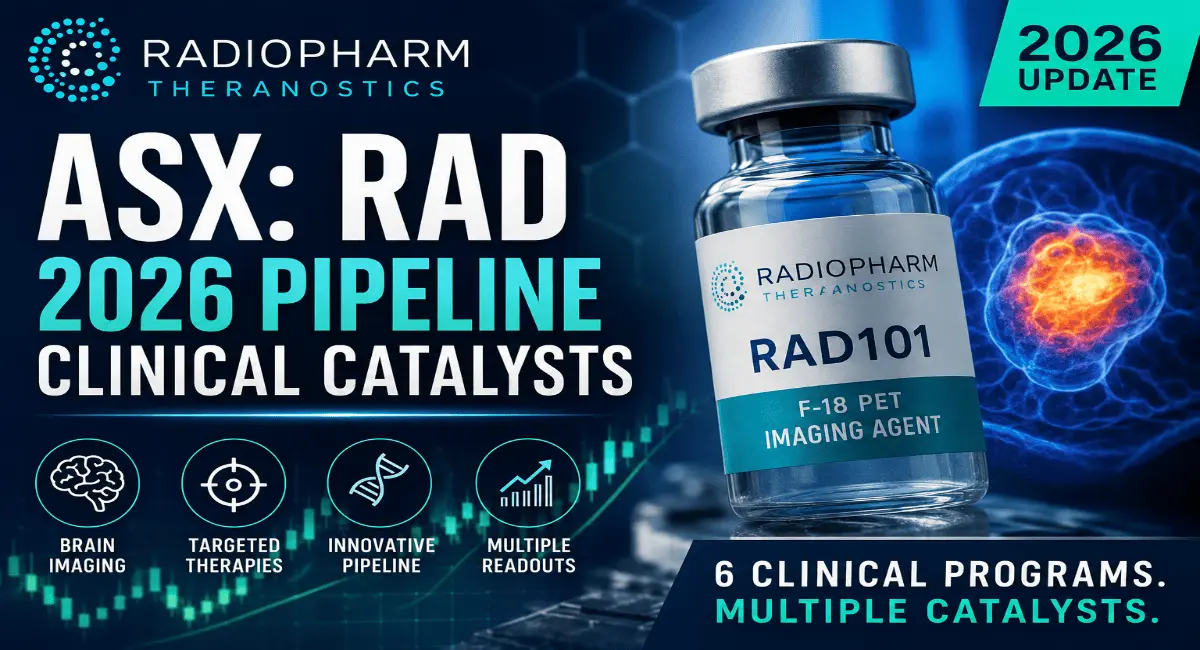
Radiopharm Theranostics (ASX: RAD, Nasdaq: RADX) has entered 2026 as one of the more closely watched names on the ASX's small-cap biotech board, with six clinical-stage radiopharmaceutical programs moving through dose escalation, enrollment completion, and first-in-human trials almost simultaneously. For a company of its size, that is an unusually dense calendar of potential catalysts — and it's why investors have been paying attention to a stock that, as of early July 2026, was trading at around AUD 0.019 per share.
Below is a rundown of where each program stands and what to watch for as the year progresses.
RAD101: The Brain Metastases Imaging Play
RAD101 is Radiopharm's most advanced asset and arguably its flagship program — a fluorine-18-labelled PET imaging agent targeting fatty acid synthase (FASN), designed to distinguish recurrent brain metastases from radiation necrosis following stereotactic radiosurgery. That's a genuine unmet need: standard MRI often struggles to tell the difference, leaving clinicians and patients in diagnostic limbo.
Interim data from the Phase 2b trial has been the standout result so far, with a high proportion of evaluable patients achieving imaging concordance with MRI — a figure the company has cited in the low-to-mid 90% range across successive updates. Enrollment in the U.S. Phase 2b study was completed earlier in 2026, and the company has flagged topline results around mid-year. RAD101 also carries FDA Fast Track Designation, and a clinical supply agreement signed with Siemens Healthineers in April 2026 is aimed at securing manufacturing and distribution as the program heads toward a planned Phase 3 launch in the second half of the year, pending the topline readout and FDA interactions on pivotal trial design.
RAD202: HER2-Targeted Radiotherapeutic
RAD202 (the "HEAT" trial) is a Phase 1 dose-escalation study of a lutetium-177-labelled HER2-targeted radiotherapeutic in advanced HER2-positive solid tumours. Dosing at the 30mCi level was completed, and the Data Safety Monitoring Committee cleared escalation to 75mCi and subsequently to a third cohort. Early data has shown considerable tumour uptake with no serious drug-related adverse events reported — an encouraging, if still preliminary, safety and activity signal. Further dose-escalation data was expected around mid-2026.
RAD204: PD-L1-Targeted Radiotherapeutic
RAD204 is advancing through a Phase 1 study spanning multiple cancer types, also using a lutetium-177 payload, this time targeting PD-L1. The second cohort completed enrollment, clearing the way for a third cohort at a 90mCi dose following DSMC approval. Early data across the first two cohorts has shown tumour uptake concentrated in PD-L1-positive lesions, again with a favourable early safety profile. As with RAD202, additional dose-escalation results are among the key mid-2026 catalysts investors are watching for.
RV-01 ("BetaBart"): The B7H3 Basket Trial
RV-01, Radiopharm's B7H3-targeting radiotherapeutic, is the company's entry into one of oncology's more competitively pursued next-generation targets. B7H3 is expressed across a wide range of solid tumours, and Radiopharm's Phase 1/2a basket trial reflects that breadth — enrolling patients with lung, prostate, breast, colorectal, ovarian, and head and neck cancers. The first patient was dosed in the first half of 2026, and initial biodistribution and safety data were anticipated around Q2/Q3 2026.
RAD402: A Differentiated Approach to Prostate Cancer
RAD402 targets KLK3 (prostate-specific antigen) using terbium-161, positioned as a potential alternative to PSMA-based radioligand therapies, which dominate the current prostate cancer radiotherapeutic landscape but don't work for every patient. The first patient was enrolled in March 2026, and the Phase 1 study is now in dose escalation among patients with advanced prostate cancer. Radiopharm has framed the differentiated target as a way to address some of the limitations seen with PSMA-directed approaches.
RAD301 and the Diagnostic Imaging Complement
Rounding out the pipeline is earlier-stage work on diagnostic imaging candidates that complement the therapeutic programs above — part of Radiopharm's broader "matched pair" strategy of pairing diagnostic tracers with therapeutic radioisotopes for the same molecular target. Initial first-in-human data from this newer program, including early safety and tumour-uptake signals, began emerging in the first half of 2026.
The Money Question: Funding the Pipeline
Running six clinical programs concurrently is expensive, and Radiopharm's cash position has moved around noticeably through the year. The company closed its first half of FY26 with roughly AUD 34.5 million in cash, guided at the time as runway into 2027. By the end of the March 2026 quarter, cash had fallen to about AUD 19.2 million after a quarterly operating burn of roughly AUD 14.9 million — a tighter position that drew attention from analysts tracking the stock. Radiopharm also raised approximately AUD 40 million in new funding around October 2025 to support the broader pipeline, and in July 2026 received close to AUD 5.89 million through Australia's R&D Tax Incentive scheme for FY25, providing an additional, non-dilutive top-up.
The pattern is fairly typical for a clinical-stage radiopharmaceutical company running multiple trials at once: capital raises, government incentives, and burn rate will likely remain as much a part of the 2026 story as the clinical data itself.
What to Watch For
Taken together, 2026 is shaping up as a genuinely pivotal year for Radiopharm, with potential catalysts including:
- RAD101 topline Phase 2b results and progress toward a Phase 3 launch
- RAD202 and RAD204 further dose-escalation data from ongoing Phase 1 trials
- RV-01 initial biodistribution and safety data from its basket trial
- RAD402 early dose-escalation data in advanced prostate cancer
- Ongoing funding updates, given the pace of cash burn across a six-program pipeline
A Note on Risk
Clinical-stage biotech investing carries substantial risk, and early-phase signals — however encouraging — do not guarantee that a program will succeed in later trials or reach regulatory approval. Share prices for small-cap radiopharmaceutical companies can also be highly volatile around data readouts and financing events. This article is for informational purposes only, is based on publicly reported company announcements and third-party coverage, and is not financial or investment advice. Anyone considering an investment in ASX: RAD should do their own research and consult a licensed financial advisor.
( Source : Market Analysis )