Copper Takes the Lead: Five ASX Stocks at the Centre of the 2026 Resources Story
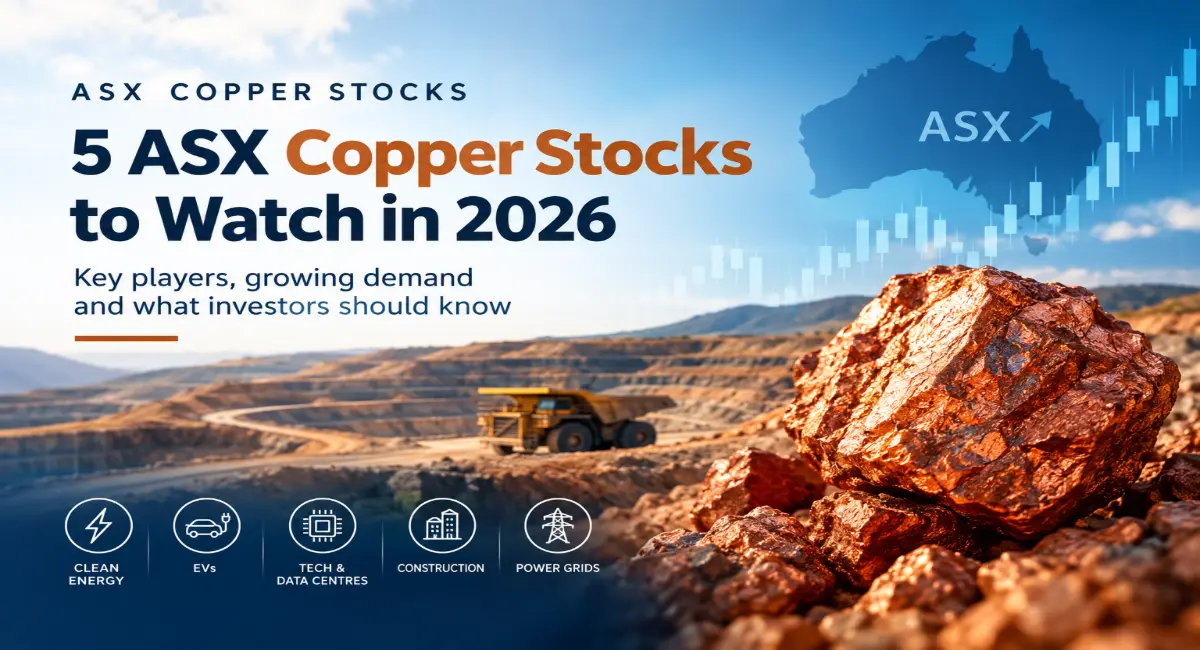
Copper has become one of the most closely watched metals in the Australian share market.
It is used in power grids, construction, electronics, electric vehicles, data centres and renewable energy systems. As more money moves into electrification and artificial intelligence infrastructure, the need for copper is also increasing.
A recent report from BetaShares found that copper contributed 34.4% of earnings from the companies in the S&P/ASX 200 Resources Index during FY2026. Iron ore contributed 33.4%.
That does not mean Australia is producing more copper than iron ore. The comparison is about earnings contribution rather than total production, exports or sales.
For me, the interesting part is how quickly copper has become more important to Australia’s largest mining companies. There are also smaller copper-focused businesses developing projects in Australia and overseas.
Here are five ASX-listed copper companies that investors and the market are watching in 2026.
BHP Group Limited (ASX: BHP)
BHP is one of the largest mining companies in the world, with copper operations across Australia, Chile and Peru.
Its Australian copper assets include Olympic Dam in South Australia. The operation also produces gold and uranium, giving BHP exposure to more than one commodity from the same mining complex.
In 2023, BHP acquired OZ Minerals. That added the Prominent Hill and Carrapateena copper mines to its Australian portfolio.
BHP also owns 57.5% of Escondida in Chile, which is the world’s largest copper mine. In Peru, the company holds a non-operating 33.75% interest in the Antamina copper-zinc mine.
The company is also involved in the Resolution copper project in Arizona, where it holds a 45% interest.
BHP reported copper production of 984,100 tonnes for the first half of FY2026. Production was broadly flat compared with the same period a year earlier, but the company reported record concentrator throughput and improved recoveries at Escondida.
It also raised the lower end of its FY2026 copper production guidance from 1.8 million tonnes to 1.9 million tonnes. The upper end remained at 2 million tonnes.
What interests me about BHP is the size and variety of its copper portfolio. It is not dependent on one mine or one country.
The company is also a diversified miner, with exposure to iron ore, nickel, metallurgical coal, potash and uranium. That can reduce the effect of a weak copper price, although it also means BHP’s performance is linked to several commodity markets at once.
Rio Tinto Limited (ASX: RIO)
Rio Tinto is another large mining company that produces copper alongside iron ore, aluminium, lithium and other materials.
Its copper portfolio includes operations in Mongolia, the United States and Chile.
The Oyu Tolgoi mine in Mongolia is expected to become Rio Tinto’s largest operation. The underground mine started production in 2023, and the company expects the site to produce around 500,000 tonnes of copper per year once the underground expansion reaches full production in 2028.
Rio Tinto also operates the Kennecott mine in Utah. The mine has been operating since 1903 and remains one of the oldest copper operations in the world.
The company has invested in underground development at Kennecott and is also developing the North Rim Skarn project. That project is expected to add further copper production once it reaches full capacity.
Rio Tinto holds a 55% interest in the Resolution copper project in Arizona and a 30% interest in Chile’s Escondida mine.
For the full year of 2025, Rio Tinto reported consolidated copper production of 883,000 tonnes, an 11% increase compared with the previous year.
What I find interesting is the potential growth from Oyu Tolgoi. The operation is already significant, but the underground expansion is expected to increase its importance within Rio Tinto’s wider business.
The company is still heavily connected to iron ore, but copper is becoming a bigger part of its long-term growth plans.
Capstone Copper Corp (ASX: CSC)
Capstone Copper is a copper-focused producer with operations in the United States, Mexico and Chile.
The company owns the Pinto Valley copper mine in Arizona. The operation has been producing copper since 1972 and is fully permitted until 2039.
Capstone also owns the Cozamin copper-silver mine in Mexico. The operation has a processing capacity of 1,000 tonnes per day and produces copper along with silver.
In Chile, Capstone operates the Mantos Blancos mine and holds a 70% interest in the Mantoverde mine. Mitsubishi Materials owns the remaining 30% of Mantoverde.
The company recently approved the Mantoverde Optimised project. The expansion is expected to increase throughput from 32,000 tonnes per day to 45,000 tonnes per day, with annual copper production expected to rise by around 20,000 tonnes.
Capstone produced a record 224,764 tonnes of copper during 2025, an increase of 22% compared with the previous year.
The Mantoverde ramp-up was one of the reasons for the improvement. The mine recorded monthly production of 10,747 tonnes in December.
What interests me about Capstone is that it is a more copper-focused business than BHP or Rio Tinto. Its results are therefore more directly influenced by copper production and prices.
That can make the company easier to understand, but it also means there is less diversification if copper prices fall.
Sandfire Resources Limited (ASX: SFR)
Sandfire Resources is a copper producer and developer with assets in Spain, Botswana, Australia and the United States.
The company’s current production mainly comes from the MATSA operations in Spain. The site produces copper, lead and zinc and has processing capacity of 4.7 million tonnes per year.
Sandfire also owns the Motheo operations in Botswana, where production is ramping up from the A4 open pit and mill.
Its Australian DeGrussa copper-gold operations were depleted in 2022 and placed into care and maintenance in 2023. The company is now working on rehabilitation at the site.
In the United States, Sandfire owns an 87% interest in Sandfire Resources America. That business is advancing the Black Butte copper project in Montana.
A pre-feasibility study for the Johnny Lee deposit at Black Butte outlined the potential for an underground operation producing around 35,000 tonnes of copper per year during its first four years.
The study reported a measured, indicated and inferred resource of 520,000 tonnes of contained copper at Johnny Lee. The nearby Lowry deposit added another 210,000 tonnes of contained copper to the resource base.
Sandfire’s December 2025 quarterly report showed copper production of 24,074 tonnes. Production fell slightly from the previous quarter because of maintenance work at Motheo and a temporary reduction in the open-pit mining fleet.
What interests me here is the combination of existing production and future development projects. Sandfire is not relying only on exploration results, but it still faces the usual operating and funding risks that come with developing new mines.
Develop Global Limited (ASX: DVP)
Develop Global is restarting production at the Woodlawn copper-zinc mine in New South Wales.
The mine previously operated before closing in 1998. Develop is now working to bring the site back into production.
The company also owns the Sulphur Springs project near Port Hedland in Western Australia. The project contains copper, zinc and silver across the Sulphur Springs and Kangaroo Caves deposits.
Its third major project is the past-producing Whim Creek copper-zinc operation, which Develop owns through a joint venture with Anax Metals.
Develop entered into a funding and offtake agreement with Trafigura to support the restart of Woodlawn. The agreement included a US$65 million prepayment facility, while Trafigura agreed to purchase Woodlawn’s production for approximately five years.
During the December quarter, copper concentrate production at Woodlawn reached 3,568 tonnes. That was a 36% increase from the previous quarter.
The company also completed an updated definitive feasibility study for Sulphur Springs. The study outlined a pre-tax net present value of AU$921 million and an internal rate of return of 59%.
The next focus for Develop includes offtake arrangements, project financing and pre-development work before a final investment decision.
Why copper matters in 2026
Copper is used across construction, electrical equipment, transport, manufacturing and renewable energy.
Electric vehicles use significantly more copper than traditional petrol-powered vehicles. Copper is also required for charging networks, solar projects, wind farms, power transmission and data centres.
The metal is often viewed as a measure of global economic activity because demand rises when construction and industrial production are strong.
However, copper prices can also be volatile. Trade disputes, weaker economic growth, mine disruptions and changes in Chinese demand can all affect the market.
The International Copper Study Group reported a refined copper surplus for the first 11 months of 2025, but it expects a deficit in 2026. The International Energy Agency has also forecast a possible 30% copper supply shortfall by 2035.
These forecasts show the longer-term supply challenge, but mining companies still need to deal with costs, approvals, labour shortages and project timelines.
Final thoughts
The ASX copper sector includes large diversified miners, established copper producers and smaller companies developing new projects.
BHP and Rio Tinto offer exposure to copper through large global mining portfolios. Capstone Copper and Sandfire provide more direct exposure to copper production, while Develop Global is focused on restarting Woodlawn and advancing its other projects.
There are also exploration companies such as Kaoko Metals, which is working on copper and gold projects in Namibia.
For me, the key point is that these companies are not all the same. Their results depend on different mines, countries, production stages and commodity exposures.
Anyone researching the top ASX copper stocks in 2026 should look beyond the copper price. Production costs, project funding, resource quality, processing capacity and balance sheet strength can all influence the outcome.
( Source : Company Announcement , Market Analysis )