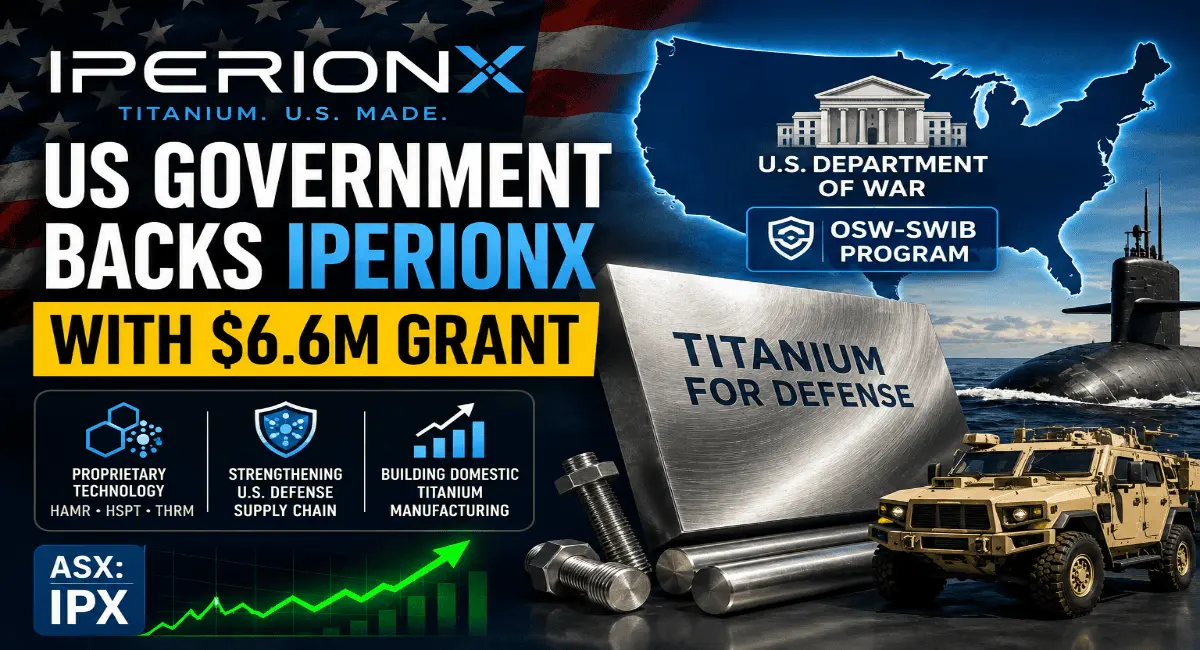
On July 1, 2026, IperionX Limited (ASX: IPX, Nasdaq: IPX) announced it had been awarded up to US$6.6 million under a U.S. Department of War program — the latest, and by no means the largest, in a growing string of American government commitments to a company that started life as an Australian critical minerals explorer and has since repositioned itself as a domestic U.S. titanium manufacturer. The market responded well: shares climbed on the news, pushing IperionX's market capitalisation to roughly AUD 1.47 billion.
So why does Washington keep writing cheques to an ASX-listed metals company, and what does this particular grant actually fund?
The Grant, in Detail
The award comes from the Office of the Secretary of War – Submarine Workforce and Industrial Base program, known as OSW-SWIB, a defense initiative aimed at scaling domestic production of high-performance titanium alloy products — including ballistic-grade titanium plate — for maritime and land defense platforms. It's structured in two phases: an initial US$0.2 million for project scoping and test work, followed by up to US$6.4 million to scale process technology and fund capital equipment, contingent on successfully completing Phase 1.
The funding will support capital equipment at IperionX's Titanium Manufacturing Campus in Virginia, specifically expanding the company's ability to produce large-format titanium components. IperionX will work alongside the George H.W. Bush Combat Development Complex and the U.S. Army Combat Capabilities Development Command's Army Research Laboratory to validate the technology and move it toward defense and strategic industrial applications. The materials in question need to meet some of the toughest specifications in defense manufacturing: high strength-to-weight ratios, corrosion resistance, durability, ballistic-impact tolerance, and shock survivability — the kind of standards required for submarines, armored vehicles, and other platforms operating in harsh conditions.
Alongside the grant, IperionX also picked up a separate purchase order from the U.S. Army Ground Vehicle Systems Center for prototype titanium fasteners destined for the Joint Light Tactical Vehicle (JLTV) — a smaller order in dollar terms, but one that could open the door to broader qualification across a much larger vehicle fleet if the prototypes perform well.
The Technology Behind the Interest
IperionX's pitch to the Pentagon rests on three proprietary technologies that make up what it calls a "powder-to-plate" manufacturing platform:\
- HAMR (Hydrogen-Assisted Metallothermic Reduction) — converts titanium minerals or recycled titanium feedstock into metal powder
- HSPT (Hydrogen Sintering and Phase Transformation) — designed to produce titanium with properties similar to conventionally wrought metal, without the traditional melt-remelt-forge process
- THRM — supports the broader powder-to-plate route
Collectively, these are aimed at cutting out energy-intensive, capital-heavy steps from conventional titanium production, which has historically depended heavily on imported feedstock and complex processing chains. If IperionX's approach works at scale, the pitch is a titanium supply chain that's cheaper, faster, and — critically for the Pentagon — entirely domestic.
This Isn't the First Check
The US$6.6 million OSW-SWIB award is notable mainly because it's the newest entry in a much longer funding relationship. Over the past 18 months, IperionX has accumulated a substantial pipeline of U.S. government support:
A US$47.1 million contract from the Department of Defense's Industrial Base Analysis and Sustainment (IBAS) program, announced in February 2025, aimed at building a resilient, fully integrated U.S. titanium supply chain "from minerals to metal." Combined with IperionX's own matching investment, the program represented a combined US$70.7 million commitment.
Progressive obligations under that IBAS contract — US$5 million for early project work, US$12.5 million in August 2025 for capacity upgrades, and a further US$25 million in September 2025 — bringing total obligations to US$42.5 million of the US$47.1 million award, with the remainder expected over the contract term. That funding is earmarked for scaling production at the Virginia campus to 1,400 metric tonnes a year.
A Small Business Innovation Research (SBIR) Phase III contract, which is structured as an Indefinite Delivery, Indefinite Quantity agreement allowing qualifying U.S. government agencies to place task orders for IperionX titanium components and parts, capped at up to US$99 million over its term. SBIR Phase III status is reserved for technologies considered ready to move from R&D into scaled production for government use — a meaningful vote of confidence in IperionX's manufacturing readiness.
Seen against that backdrop, the US$6.6 million OSW-SWIB award is relatively modest in dollar terms, but it extends IperionX's reach into a new corner of the defense industrial base — submarine and maritime platforms — while adding another government partner (the Army Research Laboratory) to its list of collaborators.
Why Washington Cares
The underlying policy logic is straightforward: titanium is a strategic material for submarines, aircraft, armored vehicles, and next-generation defense systems, and the United States has limited domestic capacity to produce it — historically relying on imported feedstock and, in some cases, processing routes tied to countries like Russia and China. Successive rounds of funding, spanning both the Biden-era IBAS solicitation process (which began in 2024) and continuing under the current administration, reflect a bipartisan-adjacent push to rebuild domestic critical minerals and metals manufacturing capacity, particularly for materials with direct national security applications.
For IperionX, that policy tailwind has translated into a rare position for a company of its size: multiple, overlapping, non-dilutive funding streams from the U.S. government, layered on top of its own capital raising, all pointed at the same Virginia manufacturing campus.
What It Means Going Forward
The immediate financial impact of the US$6.6 million award is small relative to IperionX's other commitments, but it reinforces a narrative that has become central to the investment case: IperionX increasingly looks less like a critical minerals developer and more like an emerging advanced manufacturer embedded in the U.S. defense industrial base. Each new award — whether a multi-million dollar IBAS obligation or a smaller prototype order — adds to a track record of execution and government trust that the company will likely keep pointing to as it seeks further contracts, commercial customers, and capital.
Investors will want to watch how the JLTV fastener prototype program develops, since a successful outcome could lead to larger-scale orders across the vehicle fleet, and whether the remaining IBAS and OSW-SWIB obligations are released on schedule as IperionX's Virginia facility continues to ramp toward its stated production targets.
A Note on Risk
Government grants and defense contracts, including those structured as IDIQ or task-order arrangements, provide funding ceilings rather than guaranteed revenue, and actual disbursements depend on milestones, appropriations, and program priorities that can change. Share prices for companies tied to government contract news can move sharply on announcements and may not reflect longer-term fundamentals. This article is based on publicly available company announcements and third-party reporting, is provided for informational purposes only, and does not constitute financial or investment advice. Readers considering an investment in ASX: IPX should conduct their own research and consult a licensed financial advisor.
( Source : Market Analysis )