Iron Ore, Gold & Lithium: The Ultimate Guide To ASX Materials
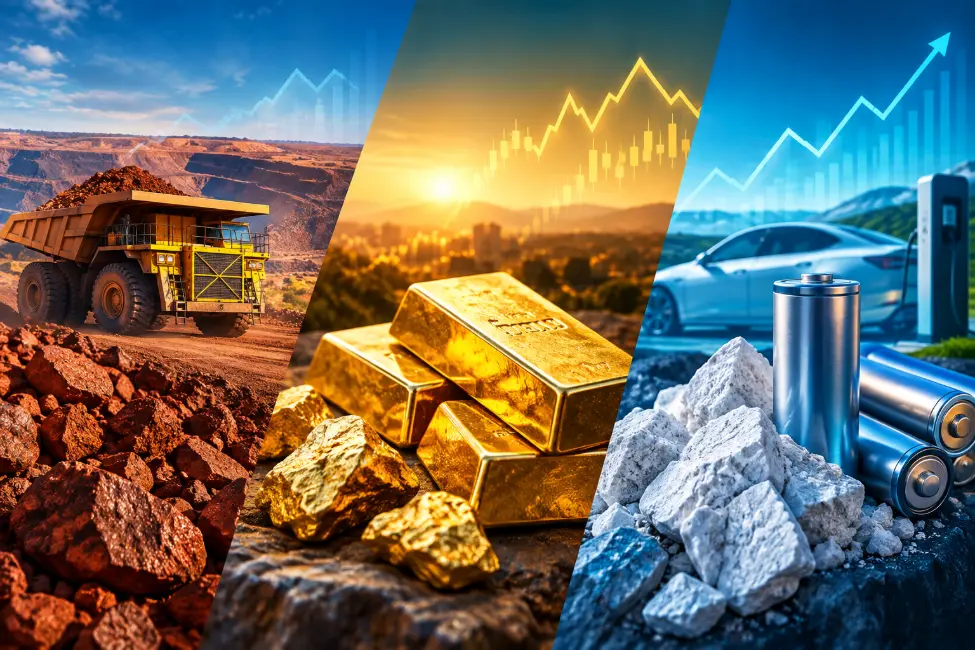
Three metals, three drastically different years. The price of iron ore has been stuck in a tug-of-war between the forces of supply and demand and has stayed largely range-bound for most of 2026. The price of gold, meanwhile, went to record highs until a brutally violent sell-off reminded everyone that even the safest of assets can be quite volatile. And lastly, lithium has enjoyed a spectacular comeback from two years of being shunned by investors to one of the best recoveries that a commodity has enjoyed in years on the ASX. Perhaps the main lesson from following all three in parallel is that the materials industry has many stories at play at one time.
Iron Ore: the big giant, mostly
Even in 2026, iron ore is still the major money spinner for BHP Group, Rio Tinto and Fortescue Metals Group. And the price of the metal has remained largely stuck in a range around the US$100 mark – it traded close to US$98 in July but occasionally dipped below that level while rising above US$108. That range is important not just the single price point, because the three giants have enough market power that small movements in the price of iron ore make a difference of billions of dollars in their profits.
On the demand side of the equation, it's largely a story of China. Real estate transactions, construction orders, and steel sector activity in China drive the iron ore story more than any domestic developments in Australia, which explains the intense focus of analysts on tracking Chinese manufacturing and steel mills' purchase activity. In terms of supply, all three of the major companies reported earnings over the course of the year that reflected this pressure BHP, with a lower than expected first-half profit and an interim dividend cut, Fortescue, with its first-half net profit more than halved, and Rio Tinto, with 8% decrease in underlying earnings and the lowest total dividend payout since 2019.
The operations at Fortescue look slightly differently from its earnings, which is an important distinction for understanding the business. Fortescue reported its record high total iron ore shipment of 201.3 million tonnes for FY2026, growing 1% compared to the previous year despite the US$750 million non-cash impairment charge on the Iron Bridge magnetite project. In the mining business, volume and profitability are not necessarily the same thing. It's possible for a company to ship record number of tons but lose money because the price per ton has declined or there are problems with a particular project.
Iron ore price forecasts are quite divergent on the path forward. One of the more pessimistic outlooks came from Westpac that expects price to drop further due to rising global supply and declining demand in China. Other desks were less gloomy but the truth is that none of them has any edge in the matter. What happens to iron ore price depends on China and that is quite hard to forecast from Australia.
Gold: the safe haven not immune to volatility
Gold in 2026 was an exciting ride for sure, and it is worth explaining in detail because it gives some insight into the meaning of "safe haven" in reality. The price of gold reached a record level close to US$5,390 per ounce on 2 March, driven by safe haven demand in the context of geopolitics tensions and purchases by central banks. About three and a half weeks later, on 26 March, it was down 18% to a level around US$4,376. The reasons for that were both specific sellers like Turkey and others who sold gold reserves to fund expenses caused by energy prices and some relief of tension around the Strait of Hormuz. In early August, gold had already managed to rebuild itself to approach records once again, trading at levels close to US$4,350 per ounce, with the ASX All Ordinaries Gold Index up 2.6% on 10 August due to the rotation back into precious metals ahead of RBA rate decision.
That record high to an 18% correction followed by another record attempt in approximately five months is the key takeaway regarding gold miners. Gold does not provide any yield and is priced in US dollars, thus performing well when real interest rates are low, and not well otherwise due to energy inflation that pushes them higher. That was basically the case in March. The three stocks that dominate gold exposure in ASX – Northern Star, Evolution Mining and Newmont – tend to boost the performance of gold due to high earnings leverage to the precious metal price because part of the cost base is fixed. For example, the numbers of Evolution Mining for the fiscal year of 2026 show that leverage very clearly: 715,000 ounces of gold production with all-in sustaining costs of only $1,717 per ounce. This resulted in record operating mine cash flow of $3.39 billion due to rising gold price.
The future course for gold is uncertain. In its latest projection, Goldman Sachs sees a price rise to about US$5,400 per ounce by the end of 2026, or about 18% above the price level in late April, on the basis of no more liquidation of central bank gold holdings, and small rate cuts by the Federal Reserve. It is one view. What the March sell-off shows is that although gold is regarded as a "safe haven," it does not trade with lower volatility — rather, it responds to a different kind of fear than shares.
Lithium: from wipeout to one of 2026's strongest recoveries
If iron ore prices have been relatively stable and gold prices have been dynamic, lithium prices have been more like a roller coaster ride. Lithium carbonate prices reached as high as US$80,000 per tonne at the end of 2022, fell below US$10,000 per tonne throughout 2024 as supply grew faster than expected, and remained in that range throughout 2025. Since December 2025 to February 2026, however, spodumene concentrate prices rose about threefold from the base level, with spot prices rising to about AUD$2,500 per tonne in January 2026, from roughly AUD$600 per tonne six months before.
Pilbara Minerals represents the best example of a clear trend leader on the ASX front, rising over 200% from the lowest point in June 2025 when shares hit $1.15 as the recovery continued to unfold. A number of different factors can be identified in playing a role in helping turn the trend. Firstly, China initiated a domestic policy to combat "excessive, unproductive competition." Secondly, a new Chinese royalty structure added $20-30 per tonne to the cost structure for domestic lepidolite producers, raising the global cost structure level and favoring larger, more integrated spodumene producers such as Pilbara Minerals, Mineral Resources and IGO over smaller, higher cost miners. From a corporate angle, South Korean steelmaker POSCO made an agreement to pay $765 million for a 30% stake in Mineral Resources' lithium division, a deal which valued the company's assets at almost 45% above consensus expectations and brought MinRes net debt down from $5.4 billion to $3.7 billion – the type of deal that validates a price floor for a whole sector.
On the fundamentals side, the key is a growing demand for lithium. Some 90% of the global demand for lithium comes from batteries, and electric cars alone are expected to make the jump from 14% of global auto sales to 33% in 2030, pushing lithium demand from 1.2 million metric tonnes to over 3 million on most forecast. Whether this demand growth will materialize as expected, and whether the price recovery will prove to be a sustained one or yet another overshoot on what has historically been a very volatile market is the question all ASX lithium investors are effectively betting on.
Understanding the sector as a whole
The resources sector requires a unique sort of attention: being able to tell what exact commodity underlies any particular stock purchase, and the fact that all three of these markets operate according to their own clocks. Iron ore is a China demand story that generally operates in well-defined ranges, with real earning changes occurring only from time to time for the three biggest producers. Gold is a macro story with interest-rate sensitivity which can fluctuate wildly in a matter of weeks in one direction or another. Lithium is a boom-and-bust cycle story linked to a single industry – electric vehicles – which are figuring out their growth prospects. None of that makes the resources sector an unattractive place to be invested in. What it does mean is that "buying resources" is a rather more difficult task than it seems, and the underlying commodity is more important than the sector designation.
( Source : Market Analysis )